Unique to the Math Intelligence Programme is also the Cognitive part of the lesson plans where the first half is usually on Math concepts while the second half focuses on cognitive development, taught through games.
Neuromath Junior believes that cognitive development is critical in young children as these are the formative years that determine how a child’s mind receives, processes and uses information and hence, memory games are often played in each class.
:: Auditory Memory
An example is that after "whole numbers and values" are taught to the class, a way that Neuromath Junior reinforced the concept was through an auditory game where the children had to move their bear counter based on the audio instructions before finally checking if their bears have ended up on the right 'number'. This
worked on not only her listening skills, spatial awareness (right, left, up and
down) but also the recognition of whole numbers and simple counting-on where the
children had to move the counter to find the mystery number.Being an audio-visual learner, this is one game which Dumpling clearly enjoys.

:: Visual Memory
Neuromath Junior also believes very much in on other areas such as memory training as this allows the children to be able to absorb more information and recall them quickly and easily. An example of how this can be useful is that when reading off instructions from the whiteboard, children are able to process the information very quickly as a whole image and hence can work on the problems quicker.

Above: here Teacher Esther puts up some 'occupational cards' for a said set of time before the children attempts to line them up in the correct order

Above: Dumpling trying very hard to recall...

Above: Dumpling with her 'super duper' camera taking a mental 'snapshot' of a beach scene...

:: IQ & Higher Order Thinking Games
In every lesson, IQ games are also being played. The objective is to train the children on their concentration, develop their spatial reasoning skills as well as ranging from their logical thinking skills. Unlike the usual tangrams available outside, Neuromath Junior creates its own materials which includes shapes with curve lines. Besides introducing to the children basic 'fractions' incidentally, Neuromath Junior develops them into creative 'pictures' which resembles animals (hones their creativity and imagination) too.
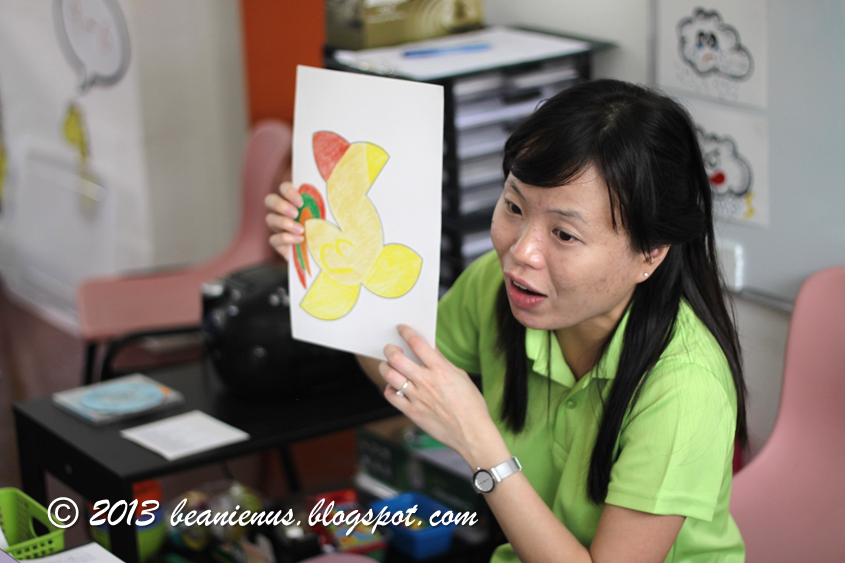
Above: picture of a rooster made with semi circles, quarters, etc

Above: Dumpling having a go at it and unused to the finer details of curved versus straight lines

Above: an activity on spatial reasoning skills

Above: Dumpling with her worksheet; trying to guess what the underside of the paper would look like
What I found really interesting was also a series of higher order thinking activities which the children were introduced to. Higher ordering thinking questions basically are non-routine problems which uses heuristic
strategies to solve the problem. There are different strategies used to solve heuristics questions one of which includes 'draw and construct'.
Draw and Construct
Dumpling's
class worked on a problem which gave them a total number of "wheels"
some vehicles (a mix of cars and motorcycles) have. The children had to work on
the sum with stickers to 'assign' the wheels where they can then identify how
many cars (4-wheeled vehicle) and motorcycles (2-wheeled vehicle) there were.
I like that even for such sums, the children had hands on tools (in this case stickers) to help them grasp the concept and the way to go about solving the problem. Having done this activity in class, the children were given another sum to attempt at home too.

Nets
Having attempted the spatial reasoning activities (shared above) for a few weeks, the children were then led to doing some Nets activities using a cube which also trains their logic reasoning and perceptual skills which aids in their understanding of geometry.


Just for Beanie N Us Readers ~ FREE TRIAL!
I am excited to share that 10 lucky winners will stand a chance to win a trial lesson worth $30!
Take part now and you can win a trial for your child to enjoy a first-hand experience of Neuromath Junior lessons!
:: Details
Each lesson is designed to cover 2 sections:1) Mathematical concepts
2) Cognitive & motor skills development
* Parents are required to accompany pupils aged 3 and 4 during the lesson.
For 5 and 6 years old trial lesson, we also welcome parents to attend with their children so that you can have a good understanding of the Neuromath Junior approach.
Date: 20 July 2013 (Saturday)
Time: 12nn (for 3 & 4YO), 2pm (5 & 6YO)
Topics:
~ Comparing Set within 10 (2 sets) (3 and 4 years old)
~ Money (5 and 6 years old)
Duration: 60 minutes
Venue: All free trial lessons will be conducted at the Upper Bukit Timah Old Fire Station Centre
Note: Trials cannot be exchanged for cash or take place on another date / time.
As the Neuromath Junior trial takes place in Singapore, this giveaway is opened only to Singapore Residents.
Winners will be chosen randomly and winners will be announced on 17 July 2013 on this blogsite and via your email address. Should you be unable to attend the trial, BeanieNUs and Neuromath Junior reserve the right to give your slot to the next winner.
By taking part in this giveaway, you agree to have your details shared with Neuromath Junior.
By taking part in this giveaway, you agree to have your details shared with Neuromath Junior.
:: Neuromath Junior Enrichment Centre
West
272 Upper Bukit Timah Road #01-13/14 Singapore 588212
(Old Fire Station @ Green Block).
272 Upper Bukit Timah Road #01-13/14 Singapore 588212
(Old Fire Station @ Green Block).
T: (+65) 6466 0145
East (Opening Soon!)
80 Marine Parade Road #17-02 Parkway Parade Singapore 449269
Email: ask@neuromathjunior.com
Disclaimer
Dumpling and I are invited to participate and review Neuromath Junior's 5YO Math Intelligence Programme in order to give my opinion of it. All opinions I have given are mine and may differ from others but were not influenced by the company or the complimentary classes given.