Showing posts with label Phonics. Show all posts

Wednesday, March 27, 2013

Wordful Wednesday - Literacy Readiness 2

I am sorry that it took so long! Following one of my earlier post which shares the first 3 tips to ‘reading’ which I touched on the first 3 points of the below:

1) Letter sounds 
2) Letter names
3) Beginning sounds
4) CVC Blends
5) Whole words / high frequency words

Here’s part 2 of the post where I would like to share a tad more on blending and some tips to whole word approach.

4) CVC
After your child has mastered the beginning sounds, the next thing to do before the blend would be to work on the ending sound. I know of parents who work with the child on the ‘middle’ sound first which is fine, but my preference is to work on the ending sound next. This is because some children may not be sensitive enough to break the word into the respective parts and may not pick up the middle sound easily.

CVC stands for Consonant Vowel Consonant - so this is where you will be blending only 3 letter words: m / a/ t. I am a firm believer of 'manipulatives' for the younger kiddos so do use magnetic letters / letter tiles and push them around with your child as you sound out the individual letters. Say the letter sounds faster and faster as you push the tiles closer and closer till it forms the word. 


Depending on the age and readiness of your child, blending requires a lot of practice before they pick up the technique. I have also shared another phonics system which Dumpling and I are using at home. In this post (last clip at the end of the post) you are able to view how Dumpling attempted to spell out a new word with me sounding it out slowly.

5) Whole words / Sight words / High Frequency words
For sight words / whole words recognition, exposure is key where you need to read, read, read a lot with your child as you point out the high frequency words again and again. There is an element of "rote" learning for such words.

However, to be able to recognise is one thing, being able to recall is another. So, to start off, work on perhaps 2 / 3 new words per week. Identify what those words are and you can try the following in guiding your child in this.

:: Look / Recite / Cover / Copy / Check 
This is a bit "old" school where we let the child look at the word, recite (spell it out via letter name) and then cover and get the child to attempt writing it out, check and repeat if necessary. If the child is older, you can practise penmanship too. Now, to make it more engaging and especially for younger learners, you can also use other "materials" for the child to write on - foam, salt, sandpaper, sand, etc.

:: Games 
Games are sure ways to commit these words to memory!

1) Bowling contest 
Paste words on toilet roll core and placing this into a formation like the bowling pins. Take turns to shout out a word and use the tennis ball to roll / hit the chosen word. (Squeals and laughter guaranteed!)

2) Words Bingo (with a twist)!
Place the various sight word cards on the floor (on anti slip mat) and take turns shouting. You can either jump / use a fly swatter to hit the words. (Mayhem guaranteed!)

3) Fill in the colour
For the arty child who likes colouring, you can prepare an outline of the words and get the child to stamp / colour via the number / colour code. With such a practice, the child is also being taught the read colours too.


4) Word Search Puzzles
Head over to sites like this where you can generate word search puzzles. Transfer the puzzle over to a word doc, change the font size and print! Great for car journeys and quiet time too! 


:: Songs
Songs are a great way for the young ones to pick up the spelling of sight words. You can search for loads of them via YouTube or you can even make up your own with popular kid songs. It is ok for the song to sound silly as long as it is catchy! 

Example: (Sing to the tune of "Mary had a little lamb")
T - H - E - Y spells out 'They'
Spells 'They', Spells out 'They'  
T - H - E - Y spells out 'They'
We can spell 'They' now! 


Once your child is comfortable with these (or if your child is reading) and you are looking for ways to encourage Creative Writing, head on over to Upside Down Homeschooling where I guest blogged and shared 5 tips! 

Have a great week ahead! 
Alicia - Mama Sue :) 

Wednesday, December 5, 2012

Advent Activities - On Board the Polar Express!

Dumpling and I do a mixture of both religious and non religious activities so besides the biblical stories/readings, we also read other classics such as Polar Express. :) 

I have been waiting for a new pack on this title having used others from other homeschoolers in the US for the past 2 years. So much so that when this pack came out, I shared the link at the start of Nov!!! :p 


We basically borrowed the title from the National Library Board (tip: reserve in advance as a lot of these Christmas titles are taken up very quickly during this period) and we bought the DVD too. 

Synopsis:

A Caldecott medalist winner, The Polar Express is about the story of a boy who has lost the belief in Christmas and in Santa. It also tells of his wonderful adventure on board the Polar Express to the North Pole to see Santa and his elves. :) Since its release, more than six and a half million copies have been sold, and every December it faithfully reappears on national bestseller lists.


For the extension into our homeschool activities, I printed the activity pack here. The pack has a good mix of simpler activities for younger tots (e.g pre-writing exercise, colouring, size sequencing) as well as activities for older children as seen below (e.g. time telling and copy work) 


We had a go on tracing (and then proceeded to spell them out phonetically) on another sheet provided behind this as part of the pack... 


We did word hunt game (Dumpling really enjoys this game) 


And there were other fun activities such as simple 1-on-1 correspondence using hot chocolate cup and marshmallows (perfect for introducing this to the younger kiddos - you can even use real marshmallows!) and this other spatial awareness game below 


As an extension, Dumpling and I also built a vocabulary list on some of the key words which were punched out on the ticket by the conductor - "Lead", "Believe", "Learn", etc. Though not biblical, this story is quite a joy for the little one. 

I will be sharing some other literature based activities which we are doing in the weeks to come. :) 

Here's some additional links to share:
- The official site 
- Games and Activities
- Free activity pack by Homeschool Share (some great pages for the older children, we attempted some pages before)
- Free activity pack by 3 Dinosaurs (good range of tot activities with pages on beginning sounds, tracing, math puzzles, etc.) 
- Free Polar Express train ticket template
- Lastly, if you do not have the book or you wish for a read aloud video as you guide your child through the book, you can view a clip of Lou Diamond Phillips here. Activity pages are also available on the same page! Enjoy!!!!


This activity is part of an Advent Activities series where we aim to share on a daily basis the various activities we are doing as we lead into Christmas!

Image and video hosting by TinyPic

If you have any posts where you can share on the spirit of giving (gifts), joy of sharing (resources/tips/ideas) or the importance of loving (musing/parenting thoughts/values, etc), please do link up!

Monday, October 29, 2012

Next step into our phonics journey ~ Jolly Phonics!

I have not blogged for quite a while on our homeschooling journey. Mainly because Dumpling and I are doing 'lesser' activities but more focused and more in depth now that she is older and we are able to discuss more. 

We are very blessed because Dumpling caught on phonics when she was loads younger and was reading independently around 2+. Once a child is able to read, everything else becomes easier.Here, she does her read aloud on one of her favourite series Mr. Men where she read Mr. Impossible for the first time. 


She is now able to attempt Math questions on her own too. I'd sit next to her and I would encourage her to attempt the questions before I check it. Here's one of her favorite activities on logic:


Hence, reading is an important skillset to develop as it does 'overlap' into other disciplines since one would need to for instance to read the instructions to be able to attempt the questions.

With her grasping the oral part and reading well, she started to create and tell her own stories. Then she started to attempt short phrases. Hence with phonics, it helps her along as she is able to 'sound out' and form the words she wanted to write.

When she was younger, we were using Letterland. Now, we are using Jolly Phonics at home. Jolly Phonics teaches both sight words and phonics and I like that there's a continuation into Grammar for Dumpling. She is at a stage where she is ready for more and the 'system' is able to support her into setting her path for Primary One.

For the kinesthetic learners, Jolly Phonics would come in handy as it offers "actions" to go with the letter sounds. Being able to read is different from being able to recall and form words / spell out. While Dumpling can already read, when we first started, I still went ahead with revising all the letter sounds just to start off. This is because what was useful for us was the grouping of the letters, the 'system' does not start with "a" but into the letter groups below:
With this unique grouping, it allows for "blending" straight from Group 1 which is different from some of the other systems out there. At a later stage, the system also teaches alternative spelling which yet again, was a useful progression for us and for kids who are ready to move beyond the basic individual letter sounds. 

On the homefront, as Dumpling was ready, we also embarked on sight words and she has able to form words and started to write short sentences:


(picture above: 'play' with 'ay' as one of the alternative spellings)


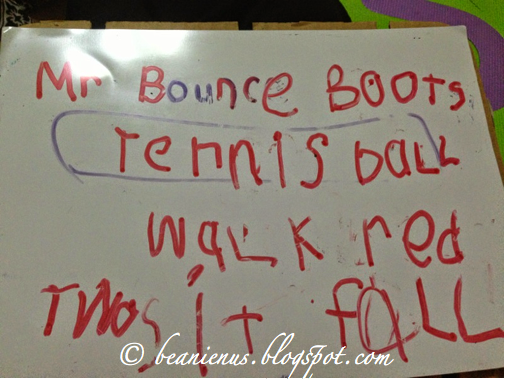
Above shows a simple activity extended from after reading Mr. Bounce. She loves these sort of word formation / spelling exercises. I like using this series as it enables us to build on her vocabulary using funny and simple stories based on the personalities of the various characters. :) And of course, we are complementing the phonics bit with other homeschooling efforts to continue to build on her critical thinking skills and her general knowledge.

One of the resources which is helpful is the letter song and you can search for these on Youtube. Additionally, if you are not against using the PC / laptop to do short bursts of activities, one of the resources which Dumpling enjoys is the phonics games CD. Here's a video from a few months back on CVC. When the answer is wrong, the acorn does not drop into the basket. This is just one of the many games the CD covers.


Progressing on from there, Dumpling has been moving along steadily on building up her phonological awareness and here's another clip to share. This was taken after reading Mr. Impossible where we started with a simple CVC blend before working on vowel patterns and then sounding out a longer word - 'habit'. 


So far, I am thankful that the phonics journey has been useful for us. With the concept of phonics, she is able to sound out words that she is unsure of. We are happy to have embarked on Jolly Phonics and Grammar for Dumpling's next phase in the English language. Though at times, it is tiring to homeschool after work / a full day of activities, I am happy to see the little one enjoying her journey and progressing well so we will continue to strive on.

How's your phonics journey? What are you using and how have your experience been? Would love to hear from you. :)

A Juggling Mom Motiviational Monday


Friday, July 20, 2012

Outdoor phonics fun - Jacob Ballas Children's Garden

I did a guest post for a friend Winnie recently  and found out that she likes the outdoors too! Hence I reached out and ask if she is able to do a post for an "Outdoor Fun" series which I have been planning to start for the longest time with the aim of promoting outdoor family fun.

Here, Winnie shares her thoughts and some tips on incorporating some phonics fun during a trip with her little one at Jacob Ballas Children's Gardens.


I understand that you are a fan of phonics! How do you use phonics during outdoor field trips?
All work and no play makes EV (my 2.5YO) a dull girl. I like to bring EV, my first born, out whenever possible, whether it is to the supermarket or the beach. Every outdoor experience is a learning experience for her. I just need to find inspiration from my little one's point of view and identify learning points that we as adults often take for granted as part of everyday life.

One of the key focus during our outdoor adventures is language. In this aspect, I try to reinforce what we are learning during our home teaching sessions and infuse the alphabet and, letter sounds. We will look for animals, insects, plants and things that allow us to practise our letters and sounds. We do that even during our walk around the neighbourhood. Besides vocalising the sounds of the names of the animals, for example, when we see a cat, I say /c/-/a/-/t/ and emphasize the 'c' sound. The purpose of this is to demonstrate that a word is made up of different sounds that are represented by their corresponding letters. I also look for other learning opportunities by pointing out the colours and shapes of the things we encounter, or we will have a short chat about the weather and how the sun is helping plants grow.


As the basis for reading and spelling, it is not enough to know the alphabet and the sounds they make. Just to share a little about phonics. An important pre-reading skill required for phonics is the development of phonemic awareness. This is an understanding of the relationship between a letter (grapheme) and a sound (phoneme). Phonemic awareness is the ability to hear, access and manipulate the sounds of a language, and helps kids understand that letters are representations of sounds. It prepares kids for more advanced phonics that involve blending skills for deciphering new words.

One of the places EV and I love to go is the Botanic Gardens. It is a conveniently located green breathing space, with a kids' friendly Jacob Ballas Children's Garden that is perfect for inquisitive little toddlers like EV.


Hunting for 'I'
It was 'I for Insect' week, so we went in search of insects or anything that started with the letter 'I'. I began the trip by telling EV the purpose and vocalised the 'I' sound and the word /i/-/n/-/s/-/e/-/c/-/t/ to her. We found lots of insects – creepy crawling ones and those that fly. It was a hot day, so many came out to play in the shade. We saw many millipedes, ants, a dragonfly, butterflies and a white insect with a feathery behind that we did not know the name of. For those that we know the names of, I voiced the sounds, paying attention to the first letter sound that the word starts with. I said, “Dragonfly. /d/, /d/, dragonfly starts with the letter d'.
 When we saw the butterfly, I reminded EV of The Hungry Caterpillar by Eric Carle, a story that I have been reading to her for a long time. We also chatted about The Grouchy Ladybug, one of her favourite books, and searched in vain for ladybugs.

We also saw ixora plants along the way, as well as a plant with 'heart-shaped' leaves called 'Pomea Batatas'.


Let's sound it again
Apart from the main theme, I also like to bring EV's attention to things she knows and make the sounds of the letters that make up those words. For example, on the MRT train on the way to Botanic Gardens, I pointed out a flower-print dress that a girl sitting opposite us was wearing. I sounded out all the letters of the word /f/-/l/-/o/-/w/-/e/-/r/, emphasising on the first letter f. I also highlighted that the word started with the letter f. Then I brought EV's attention to the orange flower design on the girl's mother's shoe. Another lady nearby was carrying a pink bag with white flower prints and EV was able to easily find it once I described it to her. Each time, I would repeat the sounds and letters to her.


EV remembered the ducks from her last trip to the Gardens, so we visited them again. Another perfect opportunity for me to revise the sounds for /d/-/u/-/c/-/k/. I was also able to explain to her how the duck feed with their beaks, move by waddling their feet underwater, bathed and preened themselves with their beaks, and fly with wings like an aeroplane.


What sound is that?
Another thing I like to do during our outdoor trips is to get EV to listen to the sounds around us. I would ask her 'what sound do you hear'. Then I prompt her to a particular sound and try to describe it to her, while trying to sound out the sound myself. At the Gardens, we heard the soft rustling of leaves blowing in a light breeze, the buzzing wings of a flying dragonfly and the splashing of a duck washing itself. The purpose of this is to fine tune her awareness of sounds, which will help as she grasps the sounds in language.
 

Words, shapes and colours around us
To help her understand that letters are representations of sounds and that a spoken word is a string of sounds while the corresponding written word is a string of letters, I like to read signs to her wherever possible, like the signs at the Gardens which describe the plants, or the labels on the MRT train.


Similarly, I point out the shapes, colours and patterns of the signs to further the learning. The Gardens is also a treasure trove of shapes, patterns and colours, like leaves of different shapes and sizes, and the flowers.

At night during story time, I ask EV questions about our outdoor trips. This gives her a chance to reflect on what she saw, allows me to reiterate where necessary and is a good way for me to gauge her understanding.

I use phonics not just during outdoor trips, but everyday too. Everything around us is a potential learning experience. The challenge is how to transform these experiences that I take for granted into fun learning points for EV. Once I do it successfully, it is always delightful to see the look of joy on EV's face once she discovers something new. It is this that keeps me going, to continually look for new things to inspire her to learn.


About Winnie Lee

Winnie Lee is a FTWM to a pair of girl and boy, aged two years and four months respectively. She home teaches and is a firm believer of play and the great outdoors.

Winnie shares her parenting and home teaching adventures at http://toddlymummy.blogspot.com/


Wednesday, February 29, 2012

The world of Letterland

I have been asked very frequently about the Phonics Program Dumpling and I use and why so I decided to post to share more here.

I am a pretty big fan of Letterland and this was shared in 2 of my previous posts here. When Dumpling was younger, we did try out some of the other phonics systems but we ended up with Letterland. Letterland is a synthetic phonics program which teaches letter sounds (rather than the names of the letters) and slowly building up to blending and spelling. We really love the program and here are some of the reasons why:

1) Stories based approach
Young children do have amazing absorbent minds but for a child to be able to remember well, it helps that it is interesting and fun. This phonics program, in my opinion, does just that. All the letters in it are assigned characters in a fictional land called “Letterland”. Each character then makes a sound which is also the starting sound of their names. For e.g. Golden Girl goes “guh guh guh” (the children are taught the hard sound first). While a lot of other phonics programs teach this, Letterland follows this through to digraphs. For e.g. “Sh” makes the sound “Shhhhh” because Sammy Snake’s (letter S) hissing sounds gave Harry Hat man a headache. So Harry Hat man turned around and puts a finger to his lips and says “shhhh”. Likewise, “Ch” has its own story too – Clever Cat’s nose was tickled by Harry Hat Man’s hat and so she makes the “Ch ch ch” sound instead of its "c c c" sound.

I personally thought that these stories are not only smart but also very engaging for young children.
 
2) Home support materials
Letterland has tons of home support materials. There are activity books for starting sounds, rhyming words, pre-writing exercises, spelling, etc. So for anyone who wants to do home learning, it is easy to follow through. Here is a quick look at the activity books but the program also offers cards, magnets. etc.

What worked very well for Dumpling was the song based approach: each letter has two songs (one on handwriting and one on letter sounds). The songs are short and catchy and in no time, Dumpling is singing to it.


Importantly, for the homelearning parent, the program also offers guidebooks for the teacher. This is great for new homeschooling parent who is clueless as to how to explain, what to do, etc. Here is a sample lesson on clever cat. So as a homeschooling parent, all we need to do is read it prior, prepare the additional materials needed (listed for each letter too) and make copies of the big picture cards.


3) Handwriting & letters recognition
Related to (2), the program not only teaches sounds but also handwriting and letter recognition. Even Upper and Lower case has its own story so the child is able to recognize that “d” and “D” are the same! This is taught very effectively through its CD Rom, Living ABC. I have previously blogged a bit about it here too to share how I used the program.

Some parents have also provided feedback on the child only recognizing the characters and not the letter shapes. I have also shared what I did to prevent that in the same link above.

4) The Queen’s English
Of course, there are many other programs out there which are good too but I wanted to have an UK phonics based system simply because that is what is being used here in Singapore. Some of the other US based programs or even DVD shows use American pronunciation and these could sound quite different from what we use locally.

5) Creative fun
Lastly, this program has a lot of fun craft ideas so it is almost like a total approach. For a young child, such craft and physical activities enable them to remember even better as it is simply so much fun! This is one of the activities from its craft book on Uppy Umbrella for a quick look. Here is another cooking activity for Munching Mike.

For homeschooling and home learning parents, this allows you to have the resources to almost teach letter systematically as each letter can be introduced on a daily basis with such creative and fun approach.


Thursday, November 17, 2011

Letterland ABC Trilogy eBooks on iPad and iPhone now!

Wow, just when I just shared Dumpling's experience using Letterland Living ABC Software and the company came up with this! :)


Click here to for a preview!  

Thursday, November 10, 2011

Literacy Readiness

Following the Chinese homelearning sharing below, I thought to share a bit on literacy readiness. Incidentally, I was having a chat with one of Dumpling’s classmates’ mum who is an Australian and she has very rightfully pointed out that in other countries, children are not expected to be able to read when they are in Primary school but that does not seem to be the same for Singapore.


And she is right of course. Just look at all the “reading” and “enrichment” centres sprouting across the island. I had a personal experience where I left my details because I wanted to visit a fairly reputable preschool as I was contemplating in the earlier days if I will homeschool Dumpling all the way through preschool. Interestingly, this school has a reading program where they were giving away complimentary reading assessments where you can then assess your kid (starts as young as 3) and see which “level” your child is at.

I only have 2 issues.

1) At 3 YO, where / which level would you expect most kids to be at? So why this unnecessary pressure?

2) The promoter could not answer / advise me when I asked how the school teaches and what methods it uses with its program. Is it pure phonics (and if so, what “system”) or whole words (how then do they attempt to teach this – flashcards?) or if the school has its proprietory program.

Needless to say, I did not turn up for the “assessment” and did not take up any of their repeated offers despite many follow up calls. Experiences as such, thus, prompted me to homeschool.

When I first started homeschooling, I did not sit down and analyse how big a task it is. I just jumped right in and the enormity of my decision only hit me much later when I suddenly realised that I alone, am responsible for her preschool years! Everything from reading to numbers to motorskills. I must confess that I freaked out a bit then. Ha ha ha…

Similarly, many mummy friends shared with me their worries, fears and how daunting it is to “teach” their child. It is just “safer” to send to the experts. It is absolutely alright with sending your child to enrichment centres but I wanted to also dedicate this post to how you can be part of the learning journey with your child, regardless if you are doing just 20 mins a day or 30 mins in 2 days.

Since “reading” seems to be such a hot topic and concern, I thought it would be apt to share what Dumpling and I do and how we do it at home. Each child’s learning style and interest is different so please adapt accordingly to best suit your child.

I have simplified the steps as below:

1) Letter sounds

2) Letter names

3) Beginning sounds

4) CVC Blends

5) Whole words

There are of course more “stages” after this – decoding of digraphs and word families, etc but I feel that once you have done the above, the rest should be much easier to catch on.

Just for today’s, I will share on points 1 to 3 otherwise; this post will be a tad too long.

1) Letter sounds

I did not teach Dumpling the letter names at all and still do not teach her now (more on that below). I started with just letter sounds for her to build the association where each letter makes a special sound. I also made a conscious effort not to teach similar looking shapes – e.g. b with d. A good reference to for the letter groups is using what Jolly phonics as a guide.

Letter sounds, to me, are more important than letter names because words are built according to sounds. For e.g. “cat” is sounded out as “ker / a / ttt” instead the child memorizing it as the letters C / A / T.

Though whole words are important (especially recognizing those on Dolch word walls), the main advantage of phonics for me is it aids Dumpling in being able to sound out words she does not know and it will definitely be useful for spelling.

For letter sounds, I only used one resource which is Letterland as I have initially shared. The CDROM is mainly song based which I personally feel is great for children.


It teaches a child the letter sounds through songs and not forgetting upper/lower case match through games and activities.

The writing of the letters is also taught using songs.


Some parents are concerned that the child will not be able to identify the letters as a standalone when it is paired with a character like that. For Letterland, I did not have such experience with Dumpling but what I did from day 1 was to also have letter tiles with us and I will get her to place it over the Letterland letter so that she can identify the standalone letter too.

I bought my Letterland items from an online seller which is not selling them now I believe. However, you can view some of Letterland's items from this seller. Two key things I like about Letterland is that you can buy other activity books and materials to support what you have learnt from the CD ROM. Additionally, it also uses the Queen's English which is what we are taught here in Singapore.

 
2) Letter names

I actually did not teach this at all but after learning all the letter sounds, Dumpling then learnt it via Leap Frog videos. A good place to get these DVDs at a reasonable rate locally is here.

 
3) Beginning sounds

Once Dumpling was able say the sound when I hold up the letters, I started building awareness of the starting word / beginning word sound. This helped her in being more aware that all letters make a sound and they then form a word. Additionally, this also set the basis of CVC blend for us.

If you like, you may wish to use the ladybird key words series C (starting from book 4). A seller at Singapore Motherhood Forum sells them here. However, what I personally did was to read a lot with her and using popular readers like “Oxford Reading Tree” and as we read, I would prompt her by placing my finger under a certain word and then emphasize the sound. For e.g. “I am kkkk /ipper” (I am Kipper).


I also read series such as the songbird phonics written by bestselling author of The Gruffalo, Julia Donaldson, amongst many orders.

As you can see, we read a lot in this household as I strongly believe that the key to reading is reading. More than that, it’s a wonderful way to bond with Dumpling as we act out parts, improvise on the story and discuss alternative endings. Nothing is as magical as going on a imaginative journey with your child and viewing her world through her language and interpretation.

This is post #1 of a 2 part series. Here's post #2 where I discussed other areas such as CVC blends and sight words too. 

Next post: should be on something math / science related? Or leave me a comment if you have a special request?

Note: I would like to add that I am not getting any commission or payment of any kind from the links provided above. I have purchased things from these sellers at one point or another and my experience has been quite positive hence the sharing.  

Saturday, November 5, 2011

Useful homeschool resources

Eversince I have homeschooled for a while, I have had some good and some bad buys. However, I have been very blessed to have been gifted with some good and useful homeschool resources too.

Here's a quick sharing of items which came in useful for me.

1) My cannot-live-without Whiteboard / Chalkboard

Gifted by a dear GF, this is especially useful ever since Dumpling has been able to trace letters and such and for me to elaborate the formation of Chinese words as well as using it for illustration / explanation of anything from Science (examples on how we record our journals) to Math readiness (introduction to number line etc.) This board is also magnetic and its good for magnetic letter / number titles and even any magnetic pieces from books we have which I can then use as manipulatives.


2) More is great when it comes to craft!


Tub of markers / crayons, etc.
Gifted with this tub of colouring pens from ELC recently. As a box of 100, there is no way I can miss them or lose them as we only take out what we need and once its done, it goes right back into the tub. With such a big container, it cannot be easily misplaced.

Of course, other colouring and craft resources from Crayola (finger paint, water colour, etc.) are great and safe resources for craft too.


3) Reading readiness
Phonics - Letterland Living ABC
I did not HS Dumpling with a said target of the achievements of certain milestones. While I am certainly thankful that Dumpling really liked books when we first started HS, I wanted to show her the basics of phonics so that she is able to sound out any new words on her own and the skill will aid her in spelling I believe. And that was all I did for phonics. With this CDROM.
For each of the letters, there are 2 songs: one for the sound of the letter and the other, a song which teaches you how to write out the letter. 1+ years on, when Dumpling gets stuck at writing, I will sing out the song and it helps her recall how the strokes should be "drawn" out.


To familiar the child with the letter sounds and the letter shapes, there are games and activities for each letter.
We will use this as and when Dumpling wants it though initially I started off with a more structured plan but it did not work for us as her attention span would differ daily and there are days when she prefers not to do phonics.
Whole words

I will publicly announce that I dislike flashcards. I use flashcards to stick on walls and boards but that's about it. I am sure I am flaunting every rule that whole word gurus advocate but it is not something which I am personally keen on because I find it boring to be flashing cards in front of my tot day in and day out.
Instead, we read. A LOT. With a whole mix of books. There are good readers out there which I do have some sets but I do not rely on them. In fact, Dumpling and I read a variety of stories, fairy tales and non fictional titles from the library.
Through the vast amount of words she is exposed to daily, she taught herself how to read. To be frank, it took us by surprise because she did not indicate that she was retaining the words. She was about to read some words here and there but before she turned 2.5, one fine day, she opened up a book, put it in her lap and sat next to me and she pointed to each word and slowly started reading. She finished the page of 3 sentences.
From there, she went through a language explosion where Dumpling is now able to read for e.g. fun stories such as Elmer and Curious George independently.

But if you are keen to encourage your child to start off with some sight words, here's a link which is both useful and fun. The key is really to read a lot with your child. If attention span is a concern, then start with short simple stories and bright pictures. You do not even need to finish the whole book but perhaps 2 pages to start off.
Dumpling likes word tracing and colouring and I downloaded a set of printables from here. Dumpling really likes colouring by number and the creater of this pack provides a simple reader in each of her unit along with activities such as "Read it, Paste it, Trace it pages", Picture/Word match and my favourites - "Word Sort that works with the new word families and CVC box printables" for word blending exercises.
Additionally, you may wish to use good readers such as these box sets from Now I'm Reading which provides rewards stickers for the child too. The sentences are kept short and through ryhmes and simple repetition, the child should catch on in time. I personally find that readers can be a tad boring but children usually do very well with repetition. And it is with this repetition that helps them gain confidence as they are able to "read" thereafter.
A lot of time, I hear my friends sharing that their kids are memorising and do not really "read". But that to me, is one of the first steps to "reading". The next step is then to help the child associate the word (by sight and placing finger under the words) to the sound of it (according to what he / she recalls.) You can look at these readers here


4) Sid and The Frizz


I am sure many of you are going "what science? Our kids are so young?" And that's the fun of homelearning as I am very sure that if Dumpling were to be in a bilingual preschool, she would not have been able to dabble as much as she can in early exposure to Science.


We use mainly 2 "series" at home: Magic School Bus and Sid the Science Kid.


While The Magic School Bus is more "serious" in tone, it is nonetheless digestible for children with its exciting field trips with their teacher, Ms. Frizzle as they fly their way from the Artic (and learn about heat / insulation) to rivers (where Dumpling learn about migration).


As for Sid, its more contemporary with 3D animation. What I like about it is that it shows real life examples / clips and encourages children to conduct the same experiments and shows charting / recording in journals which I feel is a great way for children to detail down / doodle / draw the observations.

The show also has catchy songs and funny jokes so Dumpling enjoys these tremendously too.


Both series have books and DVDs and we use a mixture of each. :)

So are preschoolers too young to know more about Science? Of course not? Dumpling understood "Reversible Change" and can explain to me in simple terms the process of photosynthesis.
How do I bring these concepts alive besides books? These very same two resources :)
Enjoy! Please do share any of your resources too!
Related Posts Plugin for WordPress, Blogger...

Be warned: All content in this blog is copyright protected.

MyFreeCopyright.com Registered & Protected