Showing posts with label Saturday Science. Show all posts

Saturday, January 7, 2017

Making Connections to the Real World - STEM Health Technology Workshop

One of the things which I feel Dumpling benefited a lot on from our early years homeschooling is that she was supported in her interest in the world around her. We made the decision to homeschool her because of her inquisitiveness and this was evident in the way she used to (and still does) question about things around us and how things work.

With the formal education system, to be honest, I feel that there's only so much that the school and teachers can do in extending on the topic of inquiry due to limitations on time and resources. At the start of last year, I organised a private STEM workshop where the children learnt about Aviation. Through the hands on team project, the kiddo understood about "thrust" and "drag" but in a really engaging manner.

In December last year, I helped coordinate another STEM workshop which is on Health Technology. The session was conducted by Yen Siow from Discovering without Borders where she is also the founder of the organisation. The objective of the workshop was to educate the children about the functions of our hearts, the biology behind it and the health technology that supports doctors. 

Yen started off with the introduction and leading the discussion with the children on the functions of the heart.

Yen, during her introduction 


A close look at the chambers of the heart. Can you spot the holes along the walls? 

 One of the workshop participants holding an occluder
(this wire mesh helps to close up holes in heart)

 Dumpling, together with her cousins, listening intently to Yen


Besides discussing closing holes in the heart, the children also learnt about heart rate, the clogging of arteries, diet, etc. Having 3 boys of her own, Yen is no stranger to engaging young children. In the workshop, Yen got the children to do a series of exercises to measure and chart their heart rate, something which they thoroughly enjoyed! 

Children holding on to "plank" for a minute to get their heart rate up
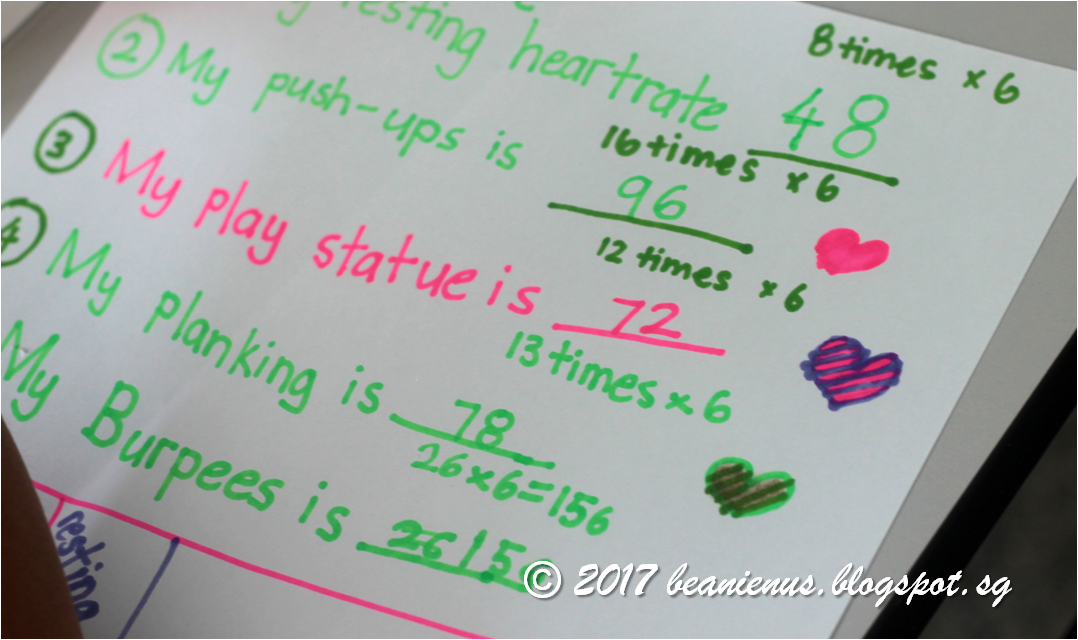
Documentation: an important part of Science. Here a participant documented her heart rate after each activity

The authenticity of the workshop shows in the sharing by Yen. Through creating their own ballooning "procedure" the concepts are made meaningful to these young participants. 


Understanding blockage in the arteries and the ballooning procedure

One thing that I learnt from Yen's workshop is that it always consists of a STEM challenge where the participants engage in a group project in building a "device" / an invention. What I personally appreciate is that Yen provides mainly recycled materials for the children to build their projects with. From a parenting perspective, I find this a good approach as I believe that children should also understand that they can have fun and build their own toys too, as opposed to parents buying them toys all the time. 


In the STEM design challenge that morning, the children were given a case study. From there, they are told to look into the "issues" of the person and to think up a device which will help the person.

The children broke out in teams where they then collaborated on the drawing and the planning of their devices to help the patients

Clearly someone had too much junk food!

Science, to me, is beautiful that way as it encourages children to question, think critically and to explore. So, when it comes to such workshops where there's group collaboration, projects and presentation, I usually take a backseat to listen and observe instead of stepping in.

The children were all given chances to speak up, explain and present their devices to their peers.

R demonstrating how the device works like a timer

No automatic alt text available.
A really cute device from another group

The device Dumpling's group came up with is a robotic dog which is able to scan and measure BP and Heart Rate, as well as dispense medication. The robotic dog (code name Alex LOL) has an inbuilt voice activated phone which the patient is able to make emergency calls too. (Seems like they watched Baymax too many times)


What I really like is that Yen's workshop goes beyond the school syllabus as the children are exposed to a larger spectrum of things and unit of inquiries. The topics are about the real world and it is about equipping our children with an understanding about the world and how they can contribute to it using STEM. I am amazed at how she was able to bring topics like Health to a level that these children not only understand but show interest in. 

The hands-on activities are of course a winner in my books. It is through the "doing" and the "tinkering" that give these children time to process and internalise, something which I find lacking in many of the instructional classes children attend these days. The STEM challenge is of course the cherry on top as it serves to tie in all the discussions they had where they now put their understanding to the "test".

The challenge encourages creativity which is clearly something Yen advocates. As she made her rounds to talk to the participants, she also probed them to think deeper with her line of questioning. She was both encouraging and enthusiastic, something which the children caught on as they happily shared and bounced their challenge ideas with her.

After attending 2 of her workshops and witnessing how the children enjoy the activities, I intend to make this a regular thing (once every 2 - 3 months) for Dumpling and her friends. If you like to join our private workshop, please drop me a line at beanienus(at)gmail.com :)

Discovering Without Borders
contact@d-w-b.org

If you have enjoyed this post, please follow me on my Facebook Page where I share my parenting thoughts (both on the kiddo and my furkid), food photos (be prepared for tons of them!), outdoor fun, useful reviews, early shout outs for giveaways and interact with you, my readers! You can also follow me on Pinterest and Instagram!  

Saturday, September 10, 2016

A fluttery affair at Science Centre Singapore!

Do you know that the butterfly:

  • Has 4 wings?
  • Can taste with their feet?
  • Can see red, yellow and green?
Those were amongst some of the things that the kiddo and I learnt about in our recent visit to Butterflies Up-Close! Developed in partnership with Sentosa’s Butterfly Park and Insect Kingdom (BIK), Butterflies Up-Close takes visitors on an immersive journey through all four stages of a butterfly’s metamorphosis – from egg to adulthood and the kiddo and I, had the chance to tour around in this latest exhibit at the Science Centre Singapore.

We are not new to the whole metamorphosis process having previously bought a kit where we witnessed the process and then setting them free. But we still found loads to marvel at, when we visited Butterflies Up-Close at the Science Centre recently.


:: The set up
One of the latest exhibits at the Science Centre Singapore, Butterflies Up-Close is segregated into 4 zones, with the last zone being the enclosure. The exhibition is simple but well thought through.

The first zone was an “introduction” from a higher level where even a World Map is placed and children can learn about some of the different butterfly species from around the world before entering the exhibition. This is where we also saw a breath-taking artwork ~ made with more than 4 thousand wings (none of the butterflies were killed for this artwork but they were specimens carefully collected by the artist over many many months). (See pic below) 


The second zone focuses on "orientation" where a key feature are big fibreglass models of a big Atlas Moth and a Jezebel butterfly so that hildren can see the main differences between the 2.

The third zone is a walk way through of the life cycle of the butterfly with fun facts where children can lift up the ladybirds to unveil the information panels and read the information.


Pic above: our guide S, getting the kiddo acquainted with the life cycle


Above pic: information panels are peppered with fun facts on these beauties

To encourage children to read up and go through the 4 zones, a small butterfly booklet is handed out where children can look for various stations at the different zones to emboss on the booklet. (See pic below)


:: The Enclosure 
The enclosure is the last part and definitely the best part of the exhibition where it is a small air-conditioned area with a dome in the centre of the room. The butterflies at the enclosure are all free range where you can observe them up close and personal.


Above pic: butterflies lapping it all up!

A glass case stands on the left side of enclosure where chrysalis and cocoons are hanging in it. I love how pretty the metalic colored chrysalis are in this case. These are all "live" chrysalis and cocoons which are slowly metamorphosing.

Here's a fun fact: do you know that the chrysalis of butterflies are different from species to species?

Look at how large the Atlas moth is!!!

Be advised that these butterflies are quite "inquisitive" and do not shy away from visitors. Over the hour that we were there, we had some that landed on our heads, shoulders, bags, and even hands. The kiddo was unfazed as frankly, they do not bite or cause any itch so she was pretty cool with them. 


The variety of butterflies there is amazing. They are specially brought into this enclosure where the temperature is specially controlled and some of them have host plants specially brought in too. 

Just check out these colorful beauties! 

(Check out the bevy of beauties)

If you are looking at an educational spiel to this, the dome houses 2 stations where one shows the magnified butterfly parts while the other allows children to interact with the exhibit to see the iridescent colors of the butterflies as they "glimmered" and "shone" at various angles. 


The enclosure is not a large one but one can easily stay there for an hour to 2 if you take the time to sit and observe. We did just that and I even managed to observe the proboscis (tongue) of a butterfly where it curled and uncurled! Here's the clip to share! :) 


Our hour there flew by so quickly that the kiddo actually asked to head back again. This will be a lovely place for an unhurried morning where you can just enjoy the cool temperature and beauty of these butterflies. 

Now, in case you are not aware, the Science Centre Singapore has waived off all entrance fees for Singapore citizens on off-peak period. Hence you only need to pay $10 for an adult / for a child and $8 for senior citizen to visit this exhibit. (Details can be found here.)

:: Location 
15 Science Centre Road
Singapore 609081
Tel: (65) 6425-2500
Fax: (65) 6565-9533
Click here for a driving map / bus information

Disclaimer: We were invited to visit Butterflies Up-Close so that we can share our experience on it. We are not compensated for the post. All opinions are entirely ours. 
If you have enjoyed this post, please follow me on my Facebook Page where I share my parenting thoughts (both to the kiddo and my furkid), food photos (be prepared for tons of them!), early shout outs for giveaways and interact with you, my readers! You can also follow me on Pinterest and Instagram!  

Saturday, April 13, 2013

Saturday Science - making slime!

For Science, Dumpling and I are still exploring the "chemistry" part on "matter". Previously we have made 'Bob the Blob' using Polymer powder. So when we came upon the page on Making Slime, Dumpling was so excited!

Off she went measuring the water...


Good way to introduce "measurement"


The main "ingredient" to make the slime...


And at this point, when we checked the manual, it read that we are to make it green so we had to use the colour tablets. This was a good way to build up from the previous experiment on colour mixing.


Then she asked me a question: 'Mama, do you think that the colours will mix together or they will be 'separated'?" I was very pleased with the question as it shows her thought process. We then made predictions...

So, we tried it out and this was a good chance for me to explain a bit on density... The colours mixed almost immediately into...


We stirred and stirred and waited for a bit (manual said to stir continuously for 5 mins but we found out that it "gel" better when we left it over night...


The slim we made were a tad too watery though it did achieve the slimy effect. So if you are using the same kit as I am, you may wanna add on more of the gravity goo powder!

Saturday, March 23, 2013

Saturday Science - Bob the Blob and Salt

Following the earlier post on making water disappear and having made Bob the Blob (yes, we named it!), I researched a bit more and found out that salt actually breaks up the molecular structure. So, hence, we decided to have a go at it and added some salt to Bob.

It certainly was a great way for the little ones to hone observation skills and patience!


This was about 2 - 3 mins after we added and we swirled the salt in. Bob's structure was broken down slowly.


And finally, this is how it looks like 5 mins later - liquid.


It was a simple and definitely easy experiment. Dumpling got to:
- Predict
- Observe 
- Compare and Contrast (I got her to draw both versions of Bob out in her journal)
- Practise her writing skills 
- Understand the various states of "matter"

Dumpling took it a step further when she got a tad sad and asked me if she can reverse the process. So that in itself, led to various few discussions and other experiments where we discussed reversible and irreversible changes. :) Stay tuned! 

This is part of a Saturday Science Series which I capture down the science moments that I do with Dumpling. Moving on, I will try to post these on every 2nd and last Saturday of the month! :D

Saturday, March 2, 2013

Saturday Science - making water disappear!

Dumpling was intrigued with one of the questions on the side panel of the Science bag - how to make water disappear? She asked me about it and we immediately dove into the handbook.

A quick read through, it seemed like an easy experiment so once again, Dumpling pretty much did most of the things on her own. ;)

The gathering list:
- 1cup of water
- 1 container (we used plastic in case of breakage)
- 1 scoop of Water Gel (Polymer) powder


First we measure the amount of powder


Then added to a container


And voila, the water disappeared! (I apologise in advance for the shaky video. Was distracted asking her on her observation :p)


So what happens here? The powder is a high absorbent powder which can hold up to 300 times its own weight with tap water. It is a crossed linked polymer which contains sodium atoms and absorbs by Osmosis. (I did not go through this in that much details with Dumpling of course but she understands that the properties of the powder changes the form of the water.)

We also titled the container upside down to test if there was any "leakage" but nope! None at all. 

Now, do you know that this powder is the same type which manufacturers use in diapers? :)

(Note: Polymer is non toxic but can irritate the eye and nasal path so as always, in all experiments, proceed with care)

Saturday, February 23, 2013

Saturday Science - colours of the rainbow!

Ever since we bought this Science kit, Dumpling has been asking to do experiments everyday!
(Source: Science bob store)

A quick flip through the guide shows that there are some experiments which she can manage almost entirely on her own and so, we started with something simple - color mixing. To be frank, I thought that it is a very simple experiment and that she would be done in 5 minutes?

But goodness, no! What seems fairly quick for me was an entirely a different experience for her. I had thought that she would be done once she got the secondary colours but Dumpling went on and on repeating the exercise and adding more of the colours where it later went on to become a colour saturation exercise. Lol.

Preschool Science
Part 1: Colour tablets and test tubes

Preschool Science
Understanding the concept of dissolving and we discussing about the release of bubbles when I asked her to observe what's happening (she asked about carbonated drinks at this stage too, specifically the dad's Coke! And what happens to all the gas which the dad takes in. 'Ahem... The gas has to exit somehow right', I replied.
 HONEY, YOU READING THIS? :P)

Preschool Science
X marks the spot - seeing how the 2 colours overlap to form a secondary colour without the actual mixing

Preschool Science
Part 2: putting it into the colour "wells" where she also had a chance to work with using a pipette. This is when she started going a bit crazy as she likes to work on these like "an adult, a real scientist mama" :p
Preschool Science

Preschool Science
The secondary colours were done

Preschool Science
Then she asked me about hues and so, I asked her to think about it and how she can try out and observed. She then experimented by dripping it slowly (good for fine motor skills and control) as she noted the change. Then she added a bit more and this went on for quite a good while...

Preschool Science
'So what happens if I mix all the colours in', she asked. I told her to find out for herself... And she did. She produced a really dirty gray which was close to black :)

Not bad to keep the little one engaged for about 20-25 mins. :)

Till next week... Mama Sue signing off!

Saturday, February 16, 2013

Saturday Science - Non Newtonian Fluids

Is it a solid or is it liquid? Dumpling has always been very into science due to her inquisitive nature.


We starting talking to her about matter, liquids and solids when she was really young. Nothing big there, more of incidental learning where it's part of our daily conversations.

She started understanding that liquids have no definite shape and after watching Magic Schoolbus, she sort of have an idea of what molecules are and how they are different between solid and liquids. Taking this further, I decided to have some fun with gloop! You can also have some fun with gloop with the younger kiddos for sensory play since it is primarily non toxic with just cornflour, water and colouring :)


And of course, this was the perfect moment to let her to estimation and measurement... So we first added the flour 


Then water (ratio of flour : water is 2:1)


Added in some food colouring for fun


Then the messy play began - she attempted to catch it


Then watched how it felt like "solid" when she caught it and attempted to mould it (force) and later became runny again. :)

Related Posts Plugin for WordPress, Blogger...

Be warned: All content in this blog is copyright protected.

MyFreeCopyright.com Registered & Protected